a smart fridge empire that is boldly on the rise

Here's the updated version:
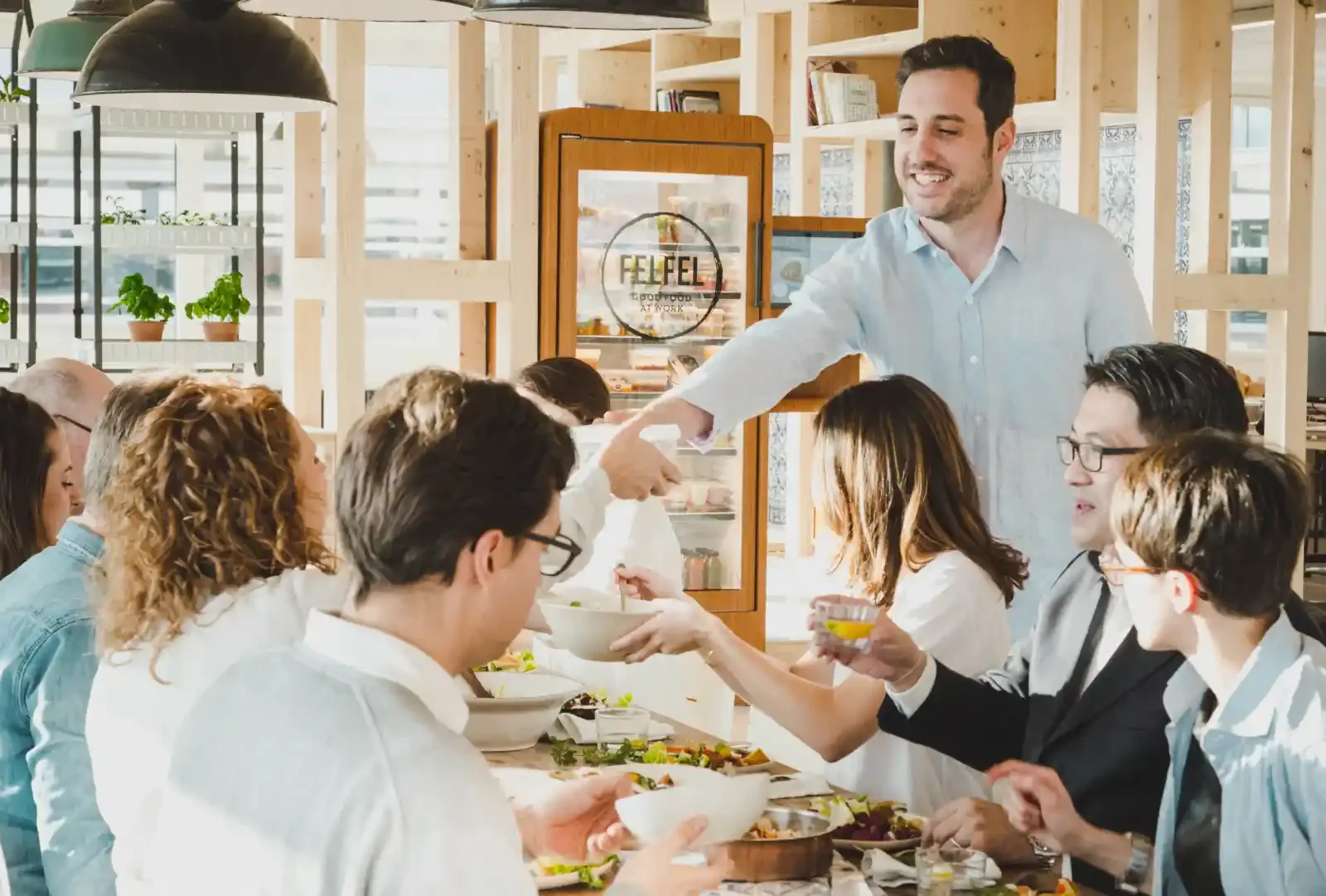
When you step into the world of FELFEL's head office in Zurich, Switzerland, it's like walking into a dream kitchen concept. Everything is bright, fresh and thoughtful. Interestingly enough, this healthy vending machine company doesn't produce any actual food on site. Because while FELFEL shows a great love and appreciation of good food, at the core they are actually a food tech company. Co-founder Emanuel Steiner explains what FELFEL brings to the company catering market.
Big computer screens on the wall show the real time data of purchases across the 800 healthy vending machines FELFEL has out in the field. On another wall, they keep track of all technical operation data, ranging from graphs that show spikes in temperature to additional errors, in order to intervene as quickly as possible.
The FELFEL journey
The idea for the company is based on a mix of personal frustration about the food on offer and Emanuel Steiner's fear of eating alone. Back in 2013, Steiner was working in Zurich city center and found that during the midday lunch break, colleagues were splitting up because they all gravitated to different offerings. Existing options were often too expensive or unhealthy, and lunch service took too long. Emanuel foresaw a food concept where colleagues could eat together for a reasonable price with a fast casual ethos.
So, together with his wife Daniela, Steiner created an attractive, seamless healthy vending machine solution that launched in 2014. In the years that followed, they further developed their AI-driven tech foundation, the logistics model and product portfolio. Together they have grown the company to 800 fridges, serving 600 clients and 150,000 people daily in offices, production locations, hospitals and schools. FELFEL's rapid growth has resulted in a team of 120 'FELFELlians,' amongst which are food scouts, customer happiness managers, mathematicians, AI-specialists, marketeers, technicians, quality controllers and order pickers.
Recently, they added their own coffee concept, Gavetti, to their proposition — born out of frustration about the abysmal quality of coffee in the typical Swiss workplace. Overall, their aim is to democratize food and drink options throughout all levels of any given company. "We are successful when we get the CEO at the same lunch table as the intern. There should be an equal offer for all," Steiner states.
How does the FELFEL business model work?
"Our clients pay a monthly service fee. This covers all of our work, machinery and logistics. We install the healthy vending machine at their location and provide employees with the FELFEL app. One fridge serves between 25 to a maximum of 250 employees. Consumers pay for the products by scanning their app. This way, we don't need cashiers and we can keep our prices low."
"In comparison to having a standard catering partner — which involves an investment of about one million Swiss francs in a proper canteen and kitchen — we are definitely the affordable option. And instead of 300 square meters we only take up 1 square meter of space. We take away all the hassle for our clients by being the main point of communication with the consumer through our customer happiness team."
"We service and restock our fridges on 800 locations every single day. As we work with fresh produce, our main focus is freshness and quality control. Our suppliers send their dishes to our HQ in Zurich and we try every single dish to make sure it meets our high standards. We only work with Swiss family-owned companies and carefully co-create all dishes together. This guarantees that the meal content in our fridges is absolutely unique and not seen anywhere else."
Who decides what products make it to the fridge?
"In house, we have a team of five food scouts. They are all trained chefs or food professionals, responsible for spotting food trends and translating those into delicious dishes with our production partners. Everything is data driven. We serve 25 different fresh products in each healthy vending machine and change the rotation weekly."
"Generally, we let the data decide what works. A client can decide to promote a certain range of dishes — to stimulate vegetarian consumption, for example — but the products found in our machines are unique to FELFEL, so there is no room for well-known A-brands."
What food trends are you currently focusing on?
"At the moment, we are developing more plant based dishes by replacing meat or fish with an alternative protein. We have poke bowls with alternative tuna and recently started putting plant based chicken in a traditional stroganoff — always ranked at the top of our sales lists. We found that if we rotate a familiar meat-based dish with a fish or plant based option, we keep the consumer engaged and slowly nudge them towards a more sustainable diet."
How important is hospitality when you have no service staff on site?
"To us, hospitality is about creating great environments for people to work in, be happy and share time together. That means having a human touch, being available and treating every request in a custom made way. Nobody in our company is ever allowed to use a template in dealing with an individual customer. Our customer happiness team consists of 20 people and they respond to 200 requests a day. They also surprise clients with occasional seasonal treats, like an ice cream surprise or smoothie pop-up in the summer."
What did the pandemic teach you?
"The pandemic taught us what people eat and drink in times of uncertainty. Our heroes during those months were ginger shots and chocolate. Our business grew substantially during the pandemic, as our food solution was safe and appropriate for demand. Before the pandemic, people spent 4.9 days in the office. We now know this has dropped to 3.5 days. Interestingly, our sales have remained almost the same — which tells us that when people go to work, they stay there, eat in more often and want to connect with colleagues."
What is the future of company catering and FELFEL?
"We first want to perfect our product here in Switzerland before rolling out abroad. We are also shifting focus more towards sustainability. Governments are not capable of solving the climate crisis fast enough — as businesses, we can do this with self initiative. With our growing number of fridges we have the power to change people's behavior for the better. We started our CO2 accounting this summer and aim to be CO2-neutral by 2026. Our decision making lines are short and I can really help push this through."
Learn more in full article: https://www.foodinspiration.com/us/a-look-at-felfel-a-smart-fridge-empire-on-the-rise/