Office Lunch Options Compared: Catering vs Delivery vs Vending vs Smart Fridge
Short answer: There is no single best way to feed an office. Catering is best for events and client meetings. Delivery works for occasional team lunches. Vending covers basic snacks. A stocked smart fridge is the best fit for a daily program in an office of 50 or more people, because it combines fresh food, all-day access and low admin. Most offices end up using more than one.
This guide compares all four on the factors that matter, so you can pick based on your situation instead of a sales pitch.
| Criteria | Catering | Office lunch delivery | Vending / micro-market | Smart fridge |
|---|---|---|---|---|
| Best for | Events, client meetings, all-hands | Occasional or recurring team lunches | Snacks and drinks | Daily meals for 50+ person offices |
| Typical cost per person (NYC) | $15 to $35, plus fees | $15 to $35, plus fees | Retail prices | Lunches from $10 (FELFEL) |
| Food freshness | Fresh, but often held after cooking | Fresh, but travels | Packaged, shelf-stable | Prepared the morning it is eaten (FELFEL) |
| Availability | One window per order | One window per order | 24/7 | 24/7 |
| Admin time | High | Medium to high | Low to medium | Low |
| Handles headcount swings | Poorly, ordered in advance | Moderately | Not applicable | Well, no minimums (FELFEL) |
| Menu variety | 1 to 3 options per order | Varies by vendor | Limited | Weekly rotation, 1,000+ recipe library (FELFEL) |
Option 1: Traditional corporate catering
How it works: You order trays or boxed meals from a caterer for a set headcount and time. Food arrives at your office and someone sets it up.
Strengths
Works well for events, client meetings and large all-hands where a shared meal is part of the occasion.
Wide choice of caterers, cuisines and service styles.
Service staff, setup and breakdown are available for high-touch events.
Weaknesses
You pay for the headcount you forecast, not the headcount that shows up.
Delivery fees, setup fees, service charges and gratuity add to the menu price.
In many NYC buildings, you need insurance certificates in advance and must book narrow loading dock or freight elevator windows.
Someone has to collect orders and dietary needs, then manage the table.
Verdict: The right choice for occasions. It is a poor fit for feeding the same team every day.
Option 2: Office lunch delivery
How it works: Employees or an office manager order from restaurants or a delivery network, and meals are dropped off for the team. Programs from vendors such as Fooda, DoorDash and others add scheduling and logistics on top.
Strengths
Real restaurant food and variety, especially when the program rotates local restaurants.
Flexible for smaller groups and one-off lunches.
Good for teams that want a social lunch on set days.
Weaknesses
Timing depends on the delivery window. Late arrivals or wrong orders affect everyone at once.
Individual orders still need collecting and sorting.
Food travels, and quality varies by dish.
Coverage is limited to the meal window. Early and late workers miss out.
Verdict: Good for recurring team lunches on specific days, or as a supplement to another program.
Option 3: Vending machines and micro-markets
How it works: A provider installs machines or a small self-service market stocked with packaged snacks, drinks and sometimes pre-packed sandwiches or salads.
Strengths
Available any time.
Low admin and a small footprint.
Fine for coffee, drinks and snacks.
Weaknesses
Food is mostly packaged and shelf-stable, so freshness and quality are limited.
Retail pricing can feel expensive to employees.
A weak draw for return-to-office or employee experience goals, because few people look forward to a vending machine.
Verdict: A useful add-on for snacks and drinks. It rarely works as the main meal program.
Option 4: Smart fridge programs
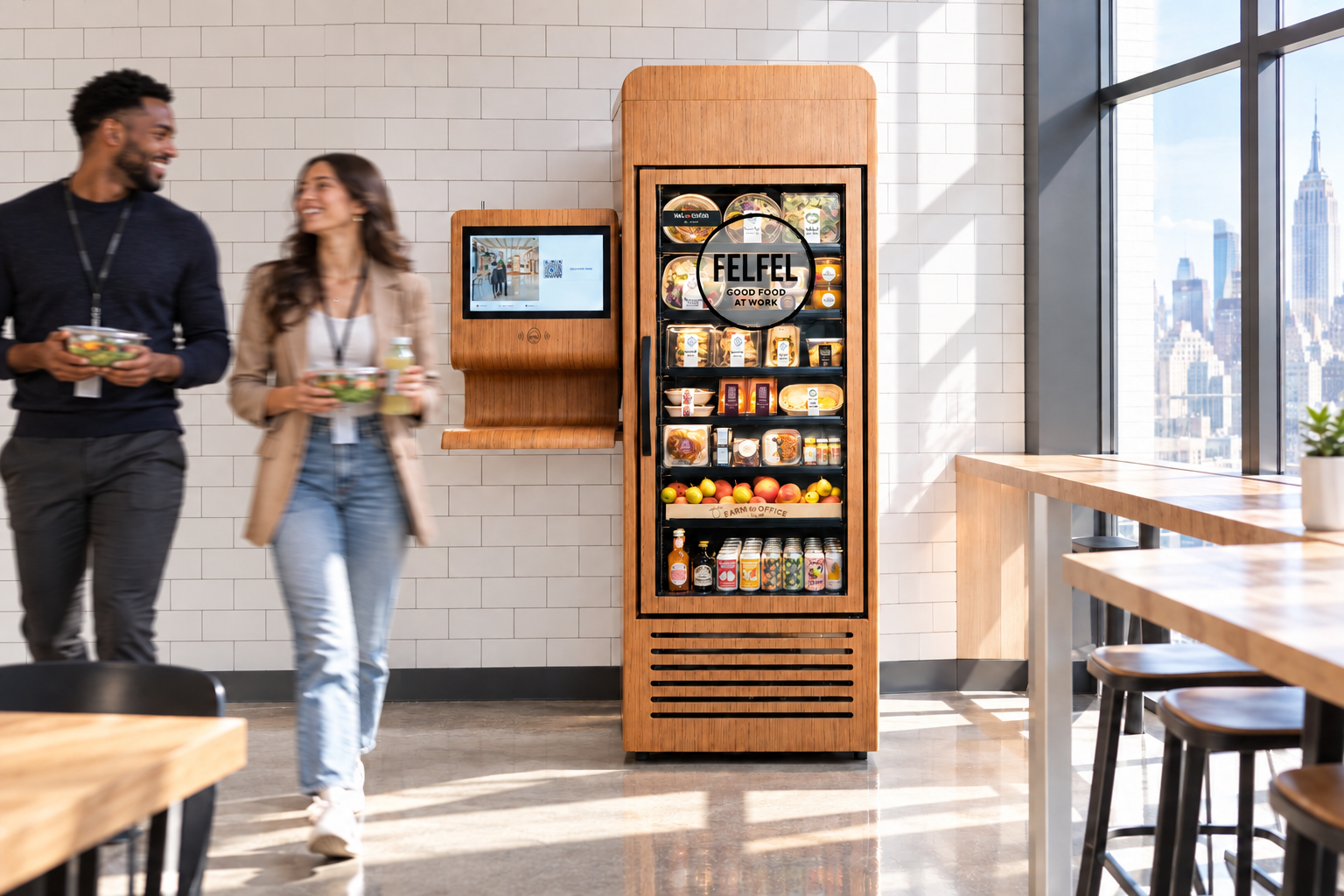
How it works: A provider places a connected fridge in your office and stocks it every workday. Employees unlock it with an app, take what they want, and are billed or subsidized through the platform.
Strengths
Available all day, which covers early shifts, late workers and hybrid schedules.
No pre-ordering, no headcount collection and no sorting orders.
The provider carries forecast risk, because the fridge is restocked daily from consumption data.
Reporting on what is consumed, plus centralized billing and subsidies.
Weaknesses
Not designed for catered events or seated client meals.
Quality depends on the provider. Some smart fridges stock packaged retail products rather than fresh meals, so check how and when the food is made.
Best suited to larger sites. FELFEL focuses on offices with 50 or more employees.
How FELFEL does it: FELFEL invented the smart fridge category more than a decade ago. Meals are cooked the morning they are eaten, in restaurant kitchens, and delivered before employees arrive. They are not frozen, shelf-stable or week-old prep. A new curated menu lands every Monday from a library of 1,000+ recipes, with vegetarian, vegan, gluten-free and dairy-free options available every day. There is no minimum order, no per-headcount fee and no tipping, and lunches start at $10. The service is available in the Tri-State Area (NY, NJ, CT) and Greater Philadelphia.
Verdict: The strongest fit for a daily, all-day program in a mid-size or large office.
How to choose: a quick decision guide
Answer these five questions:
Is this for an event or for every day? Events point to catering. Every day points to a fridge or delivery program.
How many people are on site? Under about 30, delivery may be simpler. At 50 or more, a daily stocked program usually costs less per meal and takes less admin.
Do you have early, late or hybrid schedules? If yes, all-day access matters, and a fridge or micro-market covers it.
How variable is attendance? The more it swings, the more you want a model with no minimum order.
Who will run it? If nobody has time to manage orders, choose the lowest admin option.
Common combinations that work
Smart fridge plus event catering. The fridge feeds people daily, and a caterer handles the quarterly all-hands and client lunches.
Smart fridge plus delivery. The fridge is the baseline, and a weekly team lunch is a delivered treat.
Vending plus delivery. A budget approach for small offices that do not need a daily meal program.
What to ask any provider
Is the price all-in, with no delivery, service or setup fees?
Is there a minimum order or a per-headcount fee?
When is the food made, and where?
What does a week of menus look like, and how often does it change?
How are dietary needs labeled and handled?
Can I see consumption data?
How are subsidies and billing handled?